

In the context of implementing a Smart City, the Regional Government prepares and determines a Smart City Master Plan which is prepared in a coordinated manner by regional officials assigned as coordinators for the preparation of the master plan.
The Smart City Master Plan which aims to provide an integrated and sustainable Smart City direction includes:
- Vision, Mission and Targets of smart cities
- Smart City implementation strategy
- Smart City strategic plan map during the planning years
The City Regional Government periodically, at least every year, evaluates the implementation of the master plan, reviews/assesses the relevance and suitability of the master plan to conditions and developments, and takes steps to improve, correct or adjust as needed.
Evaluation Based on Numbers
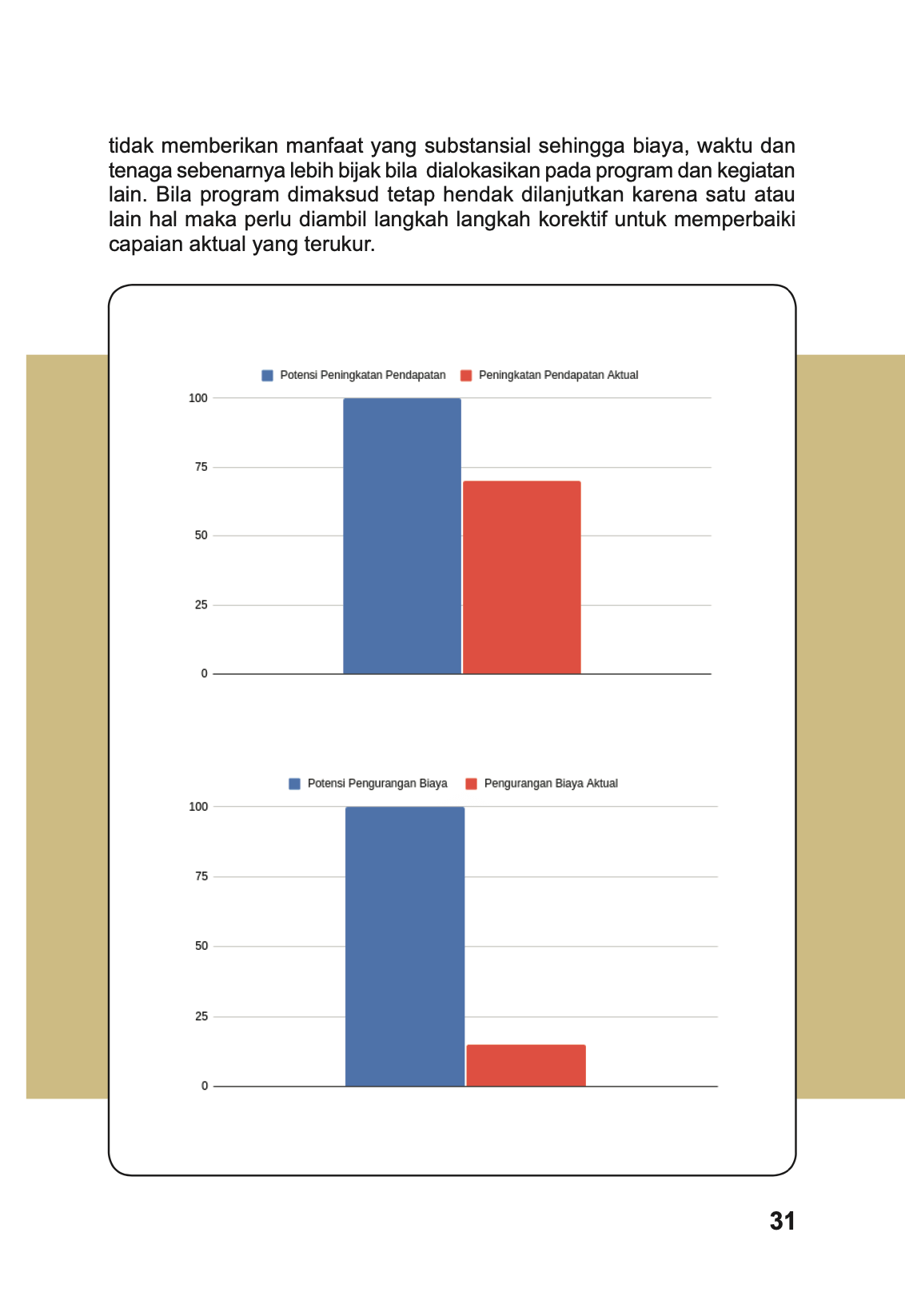
So that various innovation initiatives can be evaluated properly, a more complete study needs to be carried out so that existing problems and needs can be measured clearly. Potential targets must be assessed and determined quantitatively in the form of numbers. For example, in urban agricultural innovation, it is necessary to calculate the potential additional income of business actors and/or the community per year that can be generated from urban agriculture. Furthermore, each year each program must be evaluated for its actual achievements. Likewise, innovations aimed at reducing costs need to be evaluated with figures on how much actual savings have been achieved compared to potential savings. There can be innovations in smart cities that are interesting to talk about but do not provide substantial benefits so that costs, time and energy are actually wiser if allocated to other programs and activities.
TOWS analysis
City management is carried out through the formulation of strategies based on analysis of external factors, threats and opportunities which are increasingly important and influence urban dynamics. These factors are then examined against the internal factors, strengths and weaknesses of urban administrators. This is done through the use of a method known as TOWS.
TOWS is an abbreviation for threats, opportunities, weaknesses and strengths. This abbreviation is the same as SWOT, but TOWS focuses more on external factors that change rapidly and have a big influence on smart city implementation strategies.
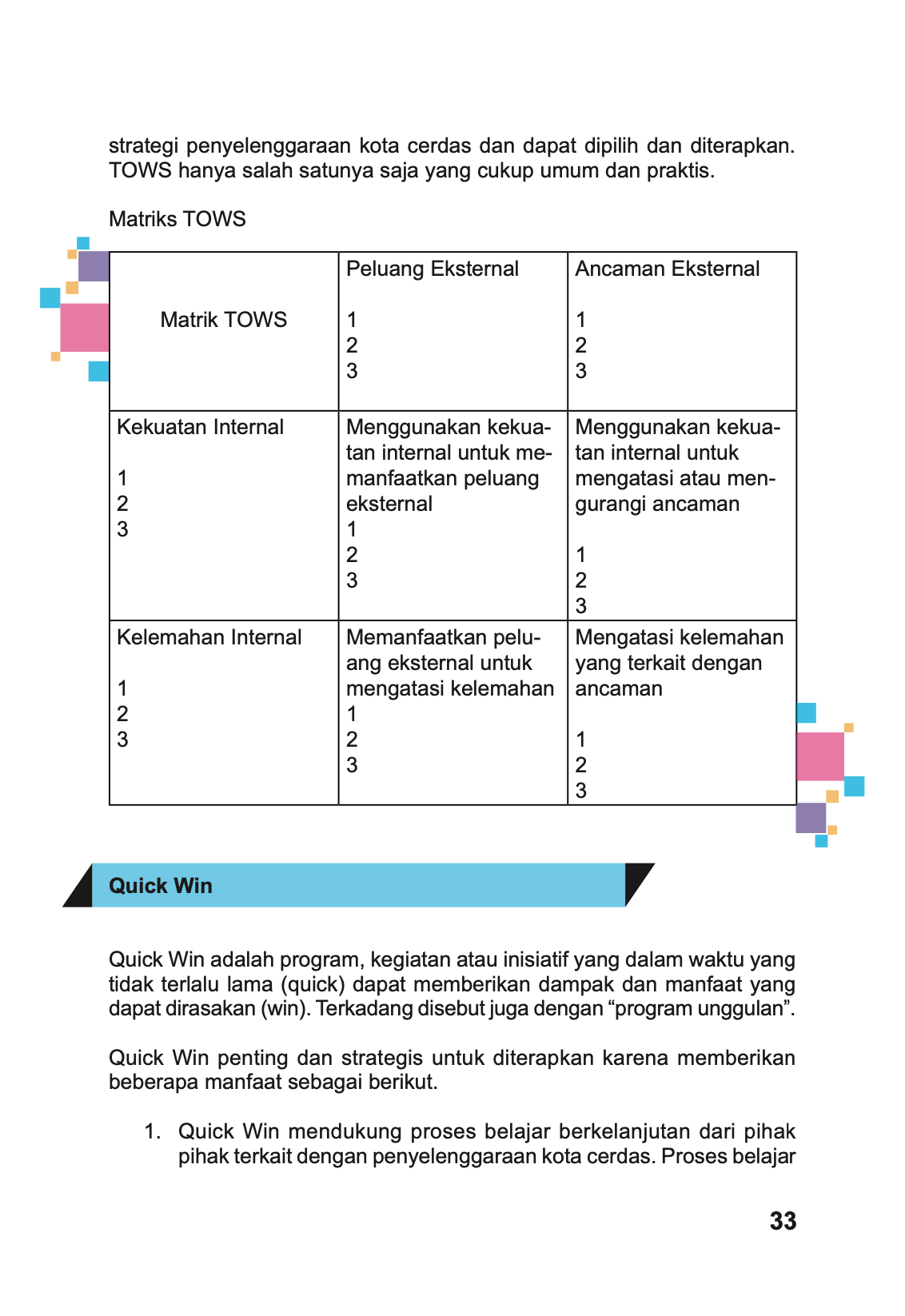
The TOWS matrix is expected to provide input on four strategies that can be used for smart city implementation. These strategies are:
- Strength/Opportunity (SO), namely utilizing the strengths you have to take advantage of opportunities.
- Weakness/Opportunity (WO), namely overcoming/or reducing existing weaknesses and taking advantage of existing opportunities.
- Strength/Threat (ST), namely utilizing one’s strengths to overcome potential threats.
- Weakness/Threat (WT), namely reducing weaknesses to avoid threats.
The effectiveness of any strategy, including TOWS, depends on several things, including:
- Accuracy and information provided requires honesty and acknowledgment of existing weaknesses, the appropriateness of stated strengths and other conditions which are facts supported by sufficient indicators and data.
- Determining a strategy must go through an in-depth thought process that can involve many parties who are free to provide input, opinions and criticism so that the strategy results take various different angles of thought taken from relevant parts according to the vision and mission of implementing a smart city.
Many other methodologies can be used in efforts to create smart city implementation strategies and can be selected and implemented. TOWS is only one of them which is quite common and practical.
Quick Win
Quick Win is a program, activity or initiative that in a short period of time (quick) can provide impacts and benefits that can be felt (win). Sometimes also called a “flagship program”.
Quick Win is important and strategic to implement because it provides several benefits as follows.
- Quick Win supports a continuous learning process from parties related to smart city implementation. The learning process is very important in building competence from the resources needed so that smart city implementation can run successfully, effectively and efficiently.
- The results of the quick win program can have the opportunity to be further developed, replicated, applied more widely, and its scalability can be increased so as to have a greater impact.
- Quick Win can provide real proof of the benefits of smart programs so as to build trust and motivation of various parties whose support is needed, including the community.
Note: Smart city management should not only focus on superior programs and quick wins. All regional apparatus in accordance with their duties and functions must strive to continue to contribute to sustainable innovation with their respective programs and activities.
Governance of Smart City Administration
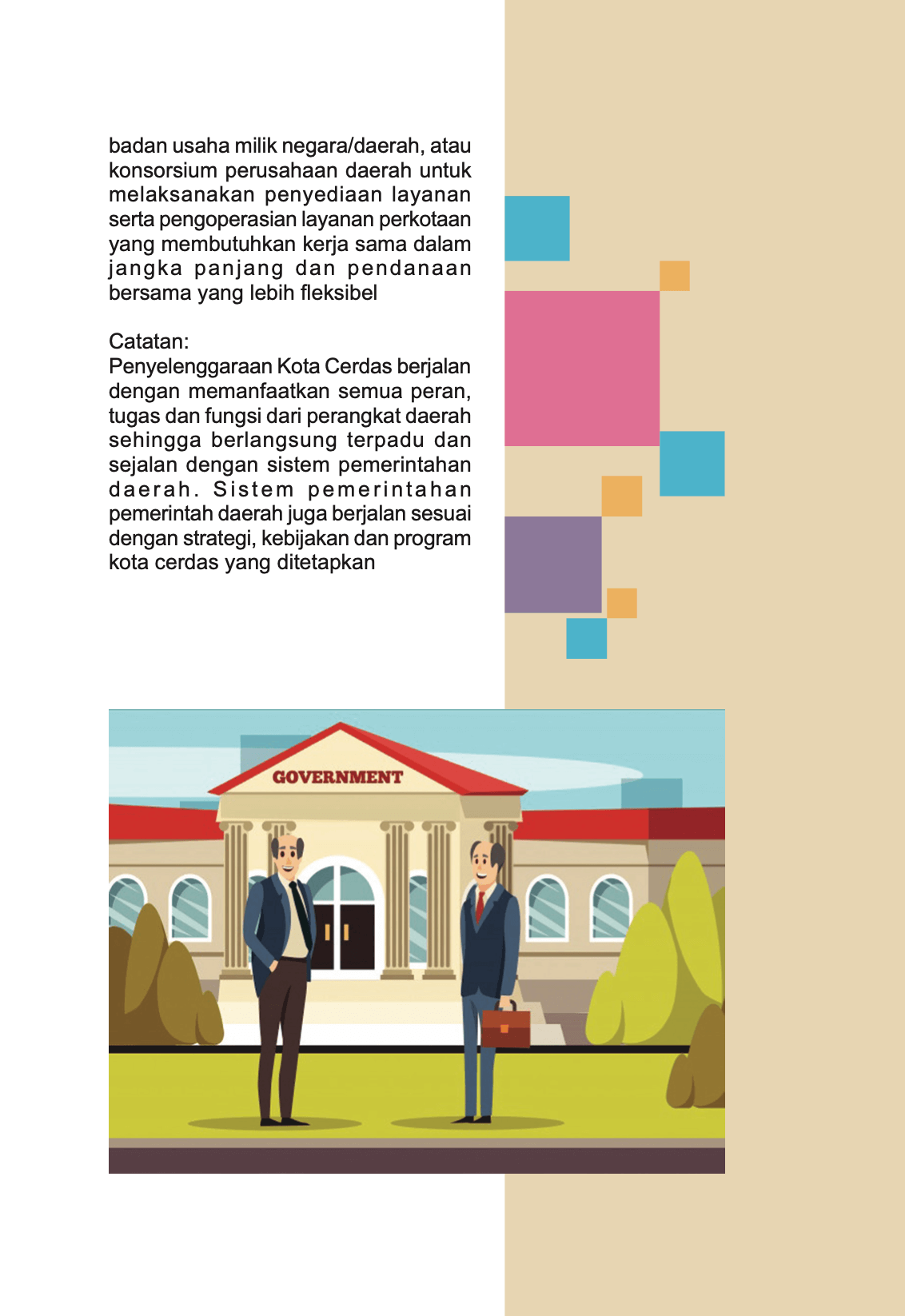
Urban management is often a question for both regional governments, urban observers and the central government itself because some parties feel that for urban areas a management institution is needed which is not only tasked with coordinating but also has an execution function, but this is not in line with the President’s mandate that they cannot form new institution because regional institutions have been divided according to affairs based on Government Regulation Number 18 of 2016 concerning Regional Apparatus. Future urban management policies will stipulate that for urban areas which are part of districts and cities as regions can form regional technical implementation units, regional public service agencies, or regionally owned business entities to carry out service provision and operation of urban services.
For urban areas located in two or more regions, this can be done through regional cooperation and within the framework of regional cooperation, an urban service provision planning coordination team can be formed to integrate urban service system plans, or a joint secretariat for urban services to plan and implement service provision and joint operation and maintenance of urban services, or urban service delivery bodies which can be in the form of public service bodies, state/regional owned enterprises, or consortiums of regional companies to carry out service provision and operation of urban services that require long-term cooperation and joint funding which is more flexible.
Note: The implementation of Smart Cities takes place by utilizing all roles, duties and functions of regional apparatus so that it takes place in an integrated manner and is in line with the regional government system. The local government governance system also runs in accordance with established smart city strategies, policies and programs.
Published by :
Ministry of Home Affairs of the Republic of Indonesia Directorate General of Regional Administration Development